

Your old contact center setup represents a multi-crore bet on efficiency. Yet for most businesses, it lands on the P&L statement as a fixed, recurring cost.
Moreover, 'a per seat or per minute expense', regardless of whether it resolves a single customer issue or saves a single rupee. In short, you're paying for the tool, not the triumph.
Almost like paying the wedding planner's full fee, even if the monsoon ruins the outdoor ceremony.
This traditional model makes your vendor a simple service provider, not a partner, placing all the financial risk squarely on your balance sheet.
But what if this entire financial model is flawed? What if you could fundamentally de-risk the investment?
Imagine a structure where your contact center's cost was directly tied to its success.
This article explores a different financial paradigm, one that forces accountability and ensures your AI investment is architected to be a guaranteed asset, not a potential liability.
Before auditing your AI's KPIs, it's time to audit its payment terms.
Is Your AI Contact Center a Financial Black Box?
Let's first diagnose how a promising technology can quietly become a money pit, undermining your P&L statement.
A money pit is an investment that continuously consumes capital over time, so much so that it exceeds the financial return it provides. The lure of AI automation is undeniable. You see the potential for massive scale, and the initial financials, often based on a seemingly low per-minute or per-seat cost, look rewarding. You go live, expecting efficiency.
But this is precisely where the financial black box appears

You are pouring money (the input) into a system based on simple usage metrics. But do you have any real visibility into how that cost translates to the successful outcomes you desire (the output)?
The AI operates as a black box where the internal logic connecting your expense to your ROI is completely opaque. You are paying for the activity inside the box, not the value it creates.
Suddenly, your contact center AI looks less like an asset and more like a classic money pit. The costs are continuous, yet the return remains a mystery hidden within the black box of its pricing model.
Are you grasping the underlying principle at play here?
The system isn't just a technical black box; its entire financial structure is one, too.
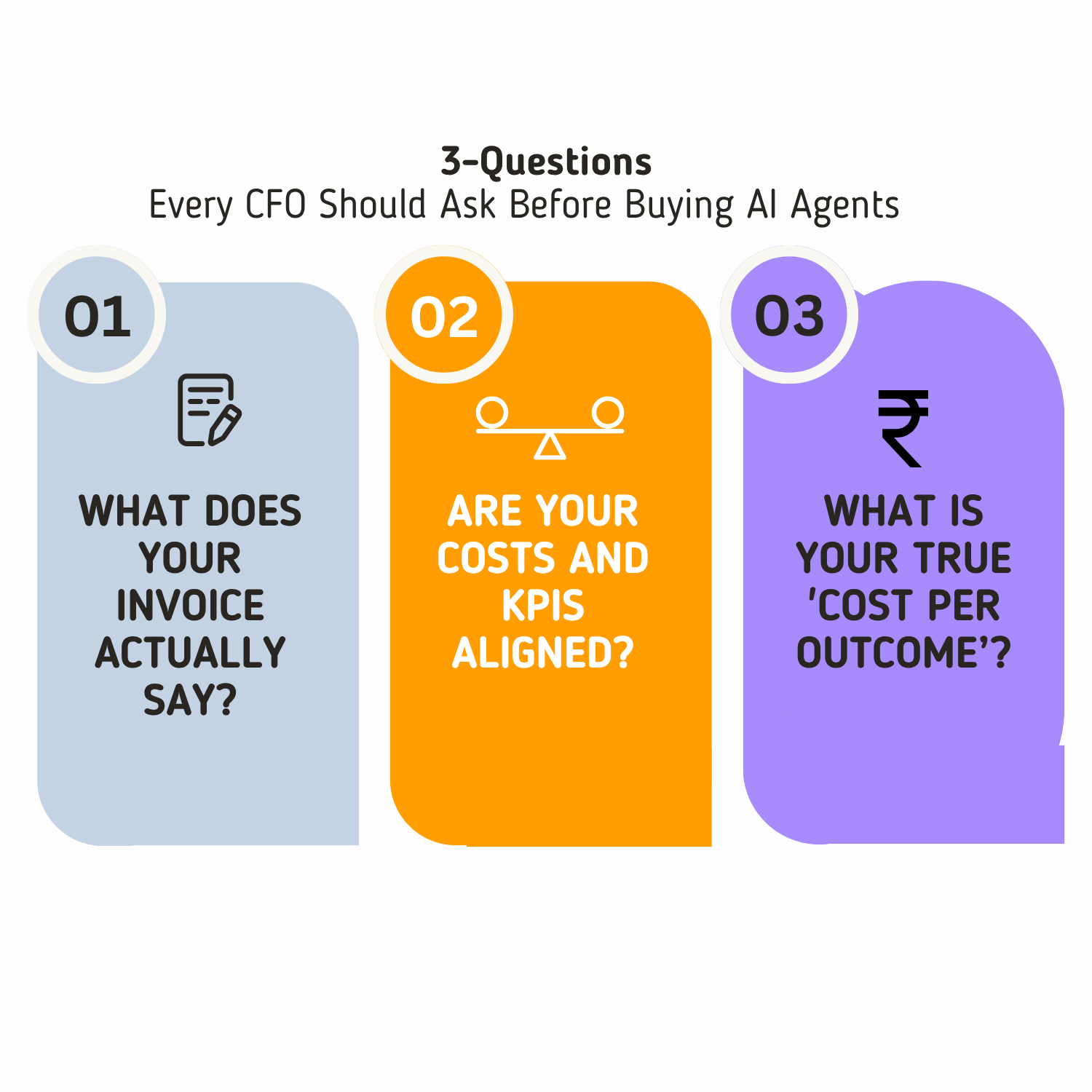
The 3 Questions Every CFO Should Ask to Dodge the Black Box
While AI voice bots are making waves in all industries and we're in complete agreement with its potential, the decision to find the right vendor/partner takes more than a google search or a few calls.
Don't worry. We've collated three questions that is a must to ask before saying, "What are the next steps?"

#1. "What Does Your Invoice Actually Say?"
Remember to look past the grand total. Are they paying for "minutes," "seats," or "sessions"?
Look past the grand total and examine the line items. Do they read like a utility bill: listing "minutes used," "sessions initiated," or "seats occupied"?
These are Input Metrics. They measure the resources you've consumed, not the value you've created.
Now, ask the critical question: How do these inputs connect to the Impact Metrics your board cares about, like "customer problems resolved" or "successful self-service interactions"? If your invoice doesn't reflect the business outcomes, you're not looking at a report on your investment; you're looking at the receipt for a financial black box.
#2. "Are Your Costs and KPIs Aligned?"
Your P&L statement and your customer experience (CX) dashboard need to have a serious conversation. A truly valuable AI is not just a cost center; it's a growth and efficiency engine.
The litmus test is simple: map your monthly AI spend on a graph against your most critical KPIs:
- First Contact Resolution (FCR)
- Customer Satisfaction (CSAT)
- The rate of human agent transfers
In a healthy partnership, the cost line should remain stable or grow slower than your value lines (FCR, CSAT), which should be climbing.
But if you see your cost line creeping up while your KPI lines remain flat or, worse, decline, that's a blaring red flag.
#3. "What is Your True 'Cost Per Outcome'?"
This is the metric that breaks open the black box. While your vendor might direct your attention to "Cost Per Minute," your focus must shift to the "Cost Per Successful Outcome."
The calculation is straightforward:
Total Monthly AI Spend ÷ The Number of Successfully Resolved Issues = Your True Cost Per Outcome.
This single number tells you exactly what you're paying to achieve one unit of success. It transforms the conversation from "How much does the AI cost to run?" to "How much does it cost to get a job done right?"
Your vendor wants you to track cost-per-minute because it's tied to their revenue. You must track cost-per-outcome because it's tied to yours.
Why Per-Minute Pricing is a Trap
While the answer is clear, let's address an integral question. Why did the traditional pricing models still exist? Time to be blunt. A per-minute or per-seat pricing model is a TRAP because it creates a fundamental conflict of interest between you and your AI vendor.
Think about it:
Your Goal: Maximum efficiency. You want customer issues resolved as quickly and accurately as possible, reducing handling time and operational costs.
A Per-Minute Vendor's Goal: Maximum consumption. They make more money when your AI is used more, not when it performs better. Longer calls and more interactions, even inefficient ones, directly benefit their bottom line.
This model makes your AI provider a toll collector on your operations, not a partner in your success. It transfers most of the performance risk onto your P&L statement.
You pay whether the AI call is a triumph of automation or a frustrating failure that requires an expensive human intervention.
Why would you accept that for a core business function?
What's the Solution Then?
The solution is to flip the model entirely. Instead of paying for access to a tool, you should only pay for the results it delivers. This is the shift from a vendor relationship to a true outcome-based partnership.
Here's how it works:
You and your partner define what a successful "outcome" looks like for your business. You only pay when one of those specific, measurable results is achieved. It's a win-win model built on mutual success and a shared understanding of value.
Examples of payable "outcomes" could be:
- A customer's query is fully resolved with or without any human intervention.
- An appointment is successfully booked and confirmed.
- A high-quality sales lead is captured and verified.
- A payment status check is completed instantly via self-service.
This model forces your partner to have "skin in the game."
It's like agreeing to pay a real estate broker their full commission only after the sale is complete and the funds are in your account.
You're no longer paying for the house viewings (the activity); you're paying for the closed deal (the outcome). This fundamentally de-risks your investment and ensures your partner is relentlessly focused on your success.
Your Next Move: Demanding a Smarter AI Partnership
You've diagnosed the black box and seen the flaw in the old model. Now, it's time to take control. Use your leverage as a customer to demand a more intelligent and financially aligned partnership.
When evaluating a new AI vendor or renegotiating with an existing one, make this your new mandate. Here are the questions to bring to the table:
- "Do you offer an outcome-based pricing model?" If the answer is no, ask them why they expect you to carry all the financial risk.
- "How do we collaboratively define and measure a 'successful outcome' for my business?"
- "How is your financial success directly and contractually tied to improvements in my key business metrics like FCR and CSAT?"
- "Can we structure a pilot program based on a 'cost-per-successful-outcome' to prove the value of your solution?"
The era of paying for AI's potential is over.

The new standard for any CFO and COO is to invest only in its proven performance. Don't just buy an AI tool because it's fancy and full of buzzwords like scalability and cost-savings.
Instead, forge a partnership that pays for itself. Get in touch with our experts to learn more.
Frequently Asked Questions
1. What is an AI contact center?
An AI contact center is the introduction of AI tools, software, or platforms to automate tasks and optimize overall contact center efficiency. This can include optimizing agent performance, automating repetitive tasks, call center operations, saving costs via scaling using automation, etc.
2. What is the contact center AI platform?
A contact center AI platform is a customer service solution used to optimize agent performance and contact center operations to enhance interactions across various channels like voice, chat, video, etc.
3. How is AI used in call centers?
AI is used in contact centers to automate tasks, enhance efficiency, and optimize operations, leading to increased customer satisfaction.
4. What is AI for customer service?
AI for customer service is a solution that can include gen-AI voicebots, chatbots, coaching solutions, etc for enhancing customer satisfaction and agent performance. These solutions are different from each other in terms of features. For e.g., Companies like Meesho AI Services provide successful outcome-based solutions that merges AI and human expertise to tackle CX.